The genetics of dragons, and the wisdom of monkeys

(remix of something I posted to my personal blog – this is Hursley-related, so it is definitely worthy of inclusion here)

I’ve spent the past two days as an activity host at the Blue Fusion event in Hursley. The title of the post will become clearer if you read on…

For those that don’t know, every year IBM participates in the UK’s National Science Week, by inviting teams of students from schools from the surrounding area to come into the lab to take part in science-based activities. The event has run for 11 years so far. Each school can bring a team of 6 students. Throughout the day they are accompanied by an IBMer (a school host), and rotate through a number of different activities (run by activity hosts). They score points according to how well they manage to complete an activity, including points for teamwork. At the end of the day, the top 3 schools win prizes. There are also a number of guest speakers, one at the beginning and one at the end of each day. We try to keep the day varied and interesting.

This is my second year as a helper. Last year I ran an activity called Kids Run e-business – basically a simulation of business process management. It was such an addictive experience that I signed up again this year. On Monday I hosted Dragonetics, which explored the ideas of genetics and inheritance by using a family tree of dragons. The students seemed to really enjoy it, and once I’d got over the initial “oops how does this work and how do I run it?” Monday morning nerves, I had a great time, too. Yesterday the activity I was hosting was testing communication skills using Morse code, semaphore, and reading Braille. Today I should be working on an activity called Search for a Planet, and tomorrow on the Virtual Athlete.

Probably the most interesting part of the day for me is seeing how different groups from different schools – and different mixes of genders in the groups – behave and work together as a team. Last year, I found that the range of behaviours was anything from highly motivated and driven to win, to relatively disinterested. So far, this year’s teams have largely been extremely motivated, although not always particularly well organised. One group had a strong leader; another one seemed to be excluding a couple of the brighter individuals through their enthusiasm for getting stuck in. The levels of teamwork and communication can vary tremendously. Based on my observations, it has seemed as though the all-female teams have been more organised to start off with, although that hasn’t always lasted or translated into success, and mixed and all-male teams have done equally well. Overall, it can be a fascinating study in psychology for those doing the hosting! The added dimension is that during the day, the scores for each activity and each school are displayed in the main hall in Hursley House, so the teams can see how they are doing compared with the others – towards the end of the day, the top few teams can become ultra-competitive, and some of those at the bottom of the table sometimes lose some of their energy.

So, why do I choose to get involved? This is a personal perspective – some other people from around the lab may have other reasons, but I guess that some will be similar.

1. It is time out from ordinary activities. For me, this has meant time to recharge, in some ways – although it is hard work, and a long day, it’s so totally different from what I normally do, it is very refreshing.
2. It is an opportunity to provide giveback to the community.
3. It involves entirely different skills from my day job. Although I do a lot of on-site mentoring / coaching / skills transfer with our customers, working with children demands an different set of capabilities.
4. For me, before I came into IT, I was always going to be a teacher – so this is also a way for me to explore that kind of experience without having to change careers.
5. It really is enormous fun. When I’m helping with Blue Fusion, I can’t wait for tomorrow to come around.


All gathered around an ambient penguin

Today saw the unusual sight of several of us charging into the pervasive lab, stopping only to use the finger print reader to open the door. Our aim…. to see Dave’s ambient penguin at work.

Dave Conway-Jones (aka DCJ), who is currently working with the Sensors and Actuators organisation in IBM, has put together a zigbee networked device attached to a postcard of a penguin. Two LEDs are in the place of the penguins eyes. When someone’s sametime instant messaging status changes (who is associated with the Penguin) the eyes go from red to green, and back again.

Its neither WiFi nor bluetooth, but some more emerging technology at work. Its also hooked up to a publish subscribe MQ broker, so asides from catching our interest en masse it is using lots of robust middleware to make sure the penguins eyes light up.

Being an ambient inidcation device there are lots of options for what the lights represent, and I think DCJ is likely to start a bit of a rush to build lots of interesting ambient devices. This is not a challenge to ambientdevices.com or the Nabaztag rabbit as neither of those feature blu-tack, selotape or card board. However the homebrew ambient device, with this simple networking technology, does have some interesting potential.

We could post a picture of it here, though I suspect the postcard of the penguin has copyright on it, and DCJ admits he was inspired by the Wallace and Grommit films, rather than the March of the Penguins or any Linux branding.

Spitfires over Southampton

This weekend five spitfires flew a tour around southamption and the surrounding area to celebrate the 70th aniverssary of the first flight of the iconic plane. Hursley has some great history related to the Spitfire. Before IBM bought Hursley park it was a development centre for amongst other things the Supermarine design team.

The Spitfire F.MK.24 was developed by the Supermarine design team at Hursley Park. In December 1940, after the devastating Blitz bombings, the control centre of the Spitfire programme was relocated to Hursley House, where it continued its operations and development.
More story here

The fly past in formation was great, but even more exciting was some practicing on Saturday where we heard the distinctive sound of Spitfires over our house, and saw them pulling some turns and generally enjoying themselves.

Spitfires

formation flying

I’m emerging

For the past couple of years I’ve been working in the Pervasive Messaging Technologies team. This has been a great time for me, for so many reasons. The team is fantastic and my manager (who recently posted here himself) is not only a great boss but also a Master Inventor. What a title! It is refreshing, in a company where you can describe your cupboard as a TSU and most people will know what you’re talking about (and many will not assume you are joking), to work in Pervasive Messaging Technologies – one of the few departments which did not reduce itself to an acronym.

Recently, and very suddenly, I was invited to participate in a twelve month job-swap with Martin Gale from Emerging Technology Services. Despite being insanely happy where I was, it seemed to good an offer to pass up. Having moved in, met new friends and learned more about old friends, posted on the department’s wiki and blog and had a crack at a couple of rather fun demos (which I’ll to post more about one day) I’m now three weeks in. Here are some observations on the move.

  • ‘Upstairs’ in Pervasive Messaging, people went for coffee. ‘Downstairs’ in ETS people go for a tea. I assume this is because of the relative proximities of the coffee bar and the Cha Bar. I have finally discovered a taste for tea without sugar.
  • The S in ETS stands for Services, and being a services team has meant I get to see more customers in the flesh. This is a good thing by the way. Being close to our customers and personally understanding what they want and need is not only essential but fun. I’m averaging over one customer meeting per week already, and I’ve barely started yet.
  • The E and T stand for Emerging Technology. This means we’re interested in new, cutting edge, innovative things. And everyone really is interested in these things. People ‘get it’, where it can be anything from how to make this server perform better to why tagging is more powerful than catagorising and why AJAX, despite being an overused buzzword, is important and useful. Hobbies and work time overlap pleasingly in an environment where today’s part-time project could be part of tomorrow’s customer demo.

So I’m enjoying it. I feel at home. The only worry so far has been this falling clock.

Fortunately Ian and I were safely in the lab at the end of the hall, but the noise of crashing metal and breaking glass was impressive.

– Roo Reynolds (Emerging Technology Services, IBM Hursley)

Update: comments closed due to oddly high levels of spam on this particular post.

Film Star for a day

On Friday, a film crew came to visit me at home for the day to film some of my home automation inventions, and talk to me about the process of innovation and how it sometimes leads to products and solutions for IBM.

The background to this is that our ad agency were hunting round the Corporation to find something “cool” to talk about in some advertising material on the web. They heard about “this guy in the UK who has electronic mousetraps”, and knew immediately this was what they were looking for.

A video conference and a few conference calls later, we’d scheduled a film shoot at my house on the Isle of Wight (a little island just off the coast of Southampton in the UK). I had been sent a “brief” about what they were planning, but I still didnt know exactly what would be entailed. So the key thing for me with regards to preparation was to make sure all the bits of my home automation system were up and running.

I’ve been playing with home automation projects for a few years now, all based around the IBM “microbroker” and MQ Telemetry Transport (MQTT) protocol for publish/subscribe messaging, which is just perfect for hooking in wizzy new gadgets in a very short time to enable me to try out new ideas.

So three car-loads of people showed up on Friday morning – 2 had flown in from the US just for the occasion – I felt very honoured already! There was the obligatory “IBM Minder” who lurks in the background making sure I don’t say anything “illegal”, or at least “highly regrettable”, or “significantly off-message”; the producer, interviewer, camera-person, sound-person, stills photographer, “key grip” (you always have to have one of those when you’re making a film, even though everyone knows that nobody fully understands the exact details of the job role!), um, er, oh, and a make up person to stop me being too shiny under the spotlights that were being assembled in my kitchen, and a few more people to make the number up to eleven.

The theme was that the interviewer drops in on this inventor chap at his very English olde-worlde home, on the ever so quaint Isle of Wight, and amongst oak beams, stone walls, thatched roof, miscellaneous dogs, and a modest herd of llamas, he would explain these wizzy gadgets he’s implemented and experimented with at home, which are generally spring boards to solutions that IBM sells to customers across a range of different industries. Experimenting with the concepts in the home environment gives me a chance to work out all the issues that make it difficult, and (very importantly) give me a demonstrable system to show to people.

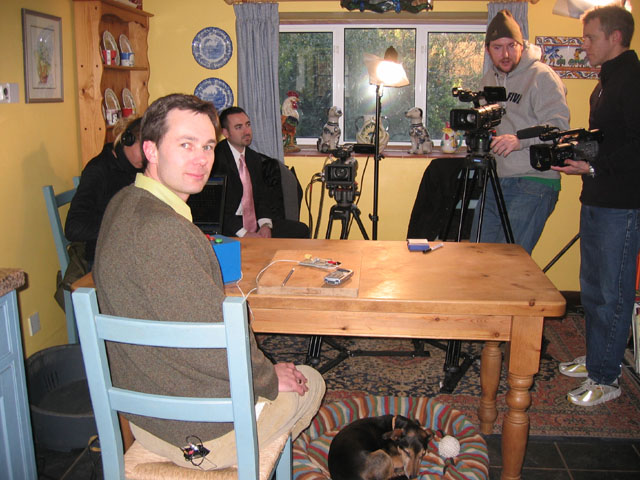
So with lights blazing, cameras rolling, and fluffy boom mic being fluffy, I showed off my power monitoring system (live graph of how much power my house is consuming), X10 lighting system controlled using MQTT from my Java-enabled cellphone (how cool is THAT!), cellphone-activated Reindeer lights in the garden left over from Christmas, and my MQTT-enabled caller ID system that screen pops the name and a picture of the person who’s calling (if the system recognises the number) on the Kitchen Computer.

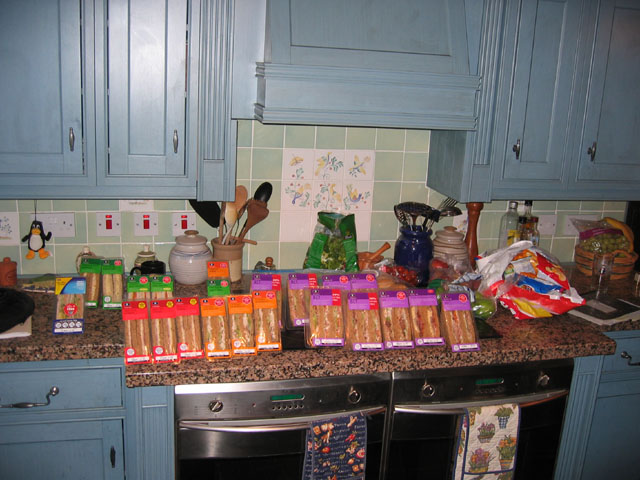
Then some of the crew went out scavenging for food (you didn’t think I was going to attempt to feed an entire film crew do you!), and they came back with, well, what can I say – I think a picture is worthwhile at this point. I think “the contents of the local shop” would be the best description! We were still eating those sandwiches on Sunday!

lunch for how many?

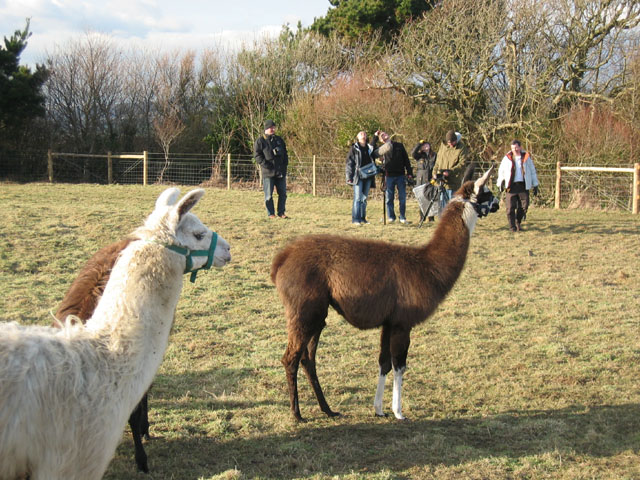
After lunch we went out to see the llamas, which the film crew instantly decided were far more interesting than me. In fact, I suspect this might end up being a film about dogs and llamas, with a voice-over by Andy Stanford-Clark! I lost count of the number of stills the photographer took of the dogs, and the makeup person, not really having a huge task, spent most of the afternoon happily playing football with the Airedale on the lawn (“to keep her out of your way”…. yeah, right!). Holding a llama on a lead in one hand, I explained to the camera how my llama tracking system will work – “track the trek with MQTT”.

llamas, camera, action!

Then we went back in the house for more interviewing, and to demonstrate the system for which I’m most famous: the electronic mousetraps, which send a message to my cellphone when one of them catches a mouse, so I know to go and reset it and dispose of the “stiff” before it starts to decompose. This simple but effective system, which publishes a “mouse event” message over MQTT to a broker out on the internet, has been running in production for 5 years now, and so is the longest-running MQTT application!

kitchen / film studio

With a looming deadline of 5.30pm, the crew went into clean-up mode, packing tripods, cameras, lights, mics, dog toys (oops!), and packing them into the cars. By 5.25 they were standing in the kitchen in their coats, thanking me so much for allowing them into my home, and showing them such cool technology.

I’m so glad I took a few photos of the day, because after they’d gone, there was not a trace that they had ever been there – I am in awe of the courtesy and professionalism that they showed throughout the day.

So there you are… film star for a day!

Andy Stanford-Clark, Master Inventor, Pervasive Messaging Technologies, IBM Hursley, UK

Go with the flow

Last night the BBC child of our time programme started. It is about the lives of a set of kids that the BBC are following/stalking throgh their lives from birth. The kids are now 5 or 6 years old. The programme itself is fascinating, especially having a 2 1/2 year old and seeing where things are heading.
However the phrase that struck me was about “Flow”. They were trying to measure the kids various amounts of “Flow”. I had not realized this was a psychologists term, though I am well aware of the principle. Flow is what happens when your mind is challenged by something and you are so engaged in the activity that time passes and you dont want to stop. We all need an activity to get Flow. Hobbies are usually what we consider as a way to get Flow, but for many of us in this sort of techland our jobs also give us Flow. For the programmers/hackers amongst us do you get ‘Flow’ when you are solving a problem, and you just “get in the zone”, “focus”. I find it also happens when I enthuse to customers and collegues
For me the emerging tech stuff, and all things around this business catch my interest and make it less of a job. Obviously video games also have the same effect on me.
I have recently been introduced to an ARG (Alternate Reality Game) called perplexcity thanks Gareth! This game you buy/trade puzzle cards, each card is a simple or very very complex puzzle, it mixes web, with pen and paper and the different styles of puzzle means that different thought styles are needed. My wife and I have realize that this has given us a combined “flow” as (apart from the BBC programme mentioned) we had the telly off and were trying to solve some of our puzzles. You start at 8 pm and before you know it it’s midnight.
So for me go with the flow used to mean not bothering and meandering along, not it means find a challenge and loose yourself in it as that feels great, either work or home.
I am not sure whether the nature of the tech industry attracts a certain type of person with a certain amount of “Flow”. The eclectic mix of technologies and the art of putting it all together, tinkering with settings, producing complex technical architectures all have a fascination for many of us in Hursley.

Hursley’s Pervasive Lab

Here in the depths of Hursley’s D-Block we have a pervasive lab. The lab is used to show lots of cool bits of technology that’s normally carried, attached to, or embedded in people and sometimes even animals. The clever bit (and the thing that makes it different from lots of other pervasive technology labs) is that it’s all connected together via some of IBM’s middleware software. That means that new bits of kit can be integrated into the lab really quickly. It’s normally a matter of configuration rather than development.

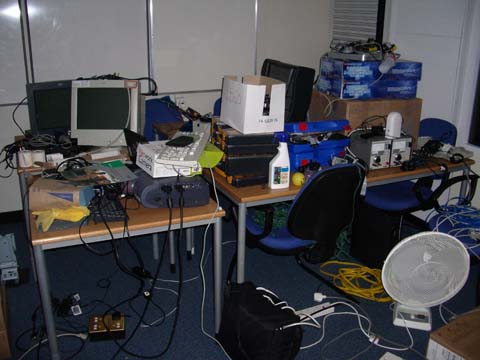
The lab had been overflowing with toys and needed room to grow. So before Christmas, some new furniture arrived. This meant that a big tidy and a rebuilding of all the kit was in order. Mid-clean, the lab kind of looked a little messy, I hadn’t realised how much stuff was actually in there.

lab before cleaning

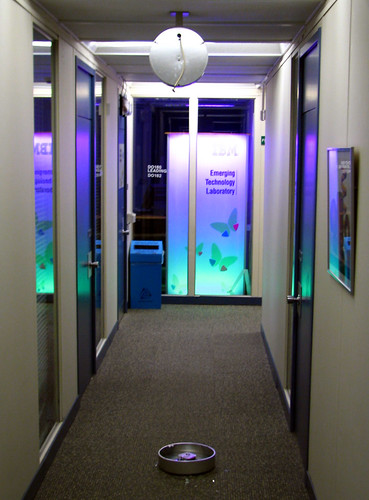
By the end though, it was starting to look pretty slick. We have some snazzy new signs and benches. All the kit will soon be up and running and I’ll try and write about some of the stuff we have in here.

pervasive lab

Game On in 48 hours

At http://lucidion.uwcs.co.uk/gce/2005/ you will find the entries that several teams from Warwick university made in a 48 hour codathon. The aim was to produce a decent quality game in 48 hours straight one weekend. I was asked to be a judge as our university relations (hi Yvonne) looked me up our internal directory and found I had been a serious gamer for many year and some experience in creating games quickly. It might be worth mentioning that there is a good book on amazon “Got Game: How the Gamer Generation Is Reshaping Business Forever ” for those people that maybe dont take gaming seriously.

Anyway, the games, and my ramblings on the games can be found all at the URL above. Enjoy

Dont forget to look at gametomorrow where we discuss the future of this type of entertainment

Ian Hughes (Emerging Technology Hursley)

Fund Raising Baking Day

I organised a fund raising ‘BAKING DAY’ for charity at work yesterday (in Hursley) to raise money for Children In Need. It was a brilliant day, so many people brought in home-baked goodies, cakes, muffins, cookies, biscuits, brownies, fudge etc and we sold them ALL. We raised quite a lot of money and had a fun day :o)

We counted the money yesterday and added the UK tax return thingy (if you are a UK resident), and it came upto just under £300. However we still have a couple of games and raffles that we haven’t collected the money for, so I will update you with our latest funds raised soon.

To see photos of what my colleagues and I baked please check out my pics.

Here is an example:
Homemade Fun Cupcakes for Sale!

—————————————————-
Who We Are Helping:
Children In Need is an annual event that raises money and gives it to charities and projects that work to improve the lives of children and young people throughout the UK.

The donated money goes towards many things including helping children with severe physical disabilities, helping underprivileged children while their mother receives treatment for a life-threatening medical condition,
looking after children with cancer, paying for therapy sessions for sexually-abused children, paying for counselling sessions for children affected by violence at home etc.